News
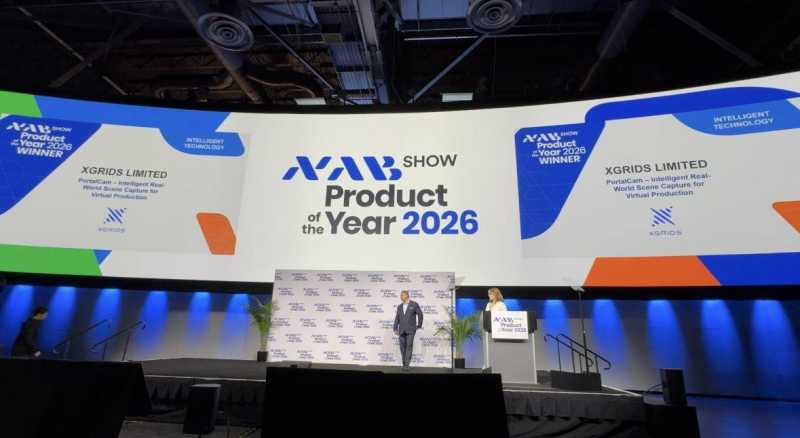
XGRIDS PortalCam Becomes Only Product to Win Four Categories at 2026 NAB Show Product of the Year Awards
XGRIDS PortalCam Becomes Only Product to Win Four Categories at 2026 NAB Show Product of the Year Awards
XGRIDS releases open format specification for production-grade 3D Gaussian Splatting workflows
XGRIDS releases open format specification for production-grade 3D Gaussian Splatting workflows
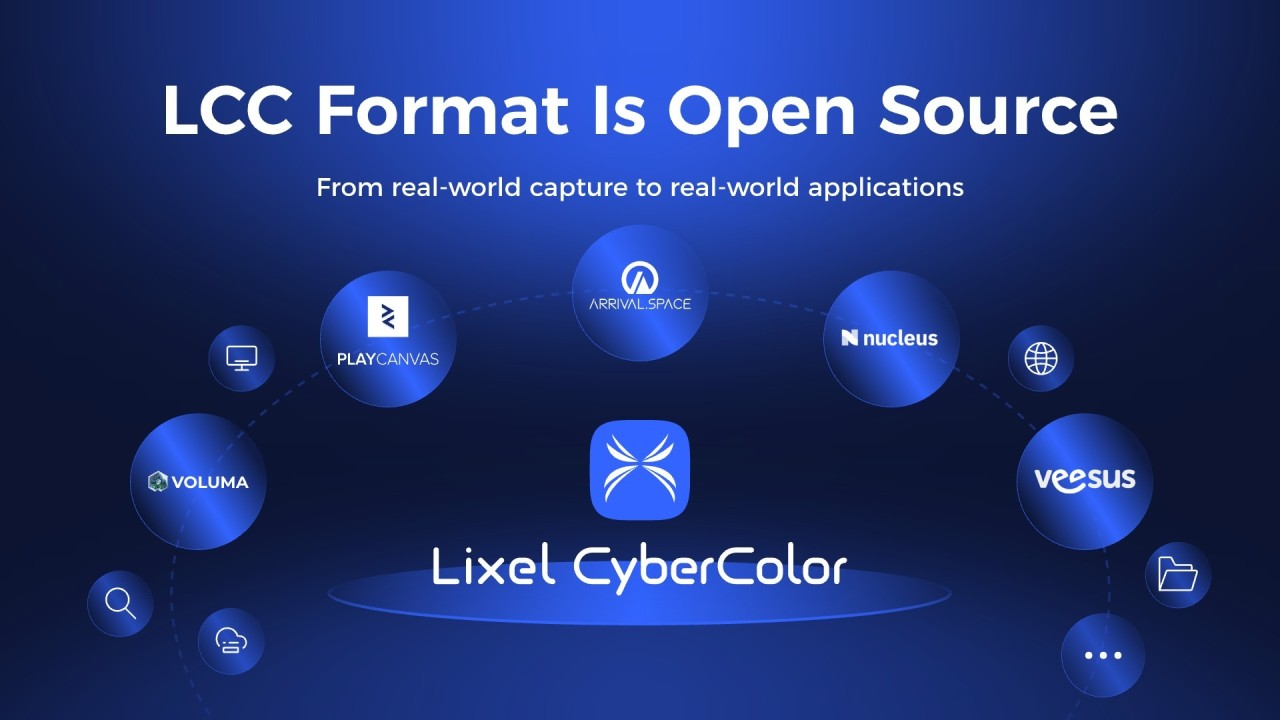
XGRIDS is open-sourcing the LCC (Lixel CyberColor) format—the data structure powering our 3D Gaussian Splatting workflows. This moves LCC from a proprietary format to an open standard enabling collaboration, transparency, and innovation across the 3DGS community.
By opening LCC, we're giving back to the ecosystem, empowering developers, researchers, and creators to build on our work and helping 3DGS become true infrastructure for spatial computing and world modeling.
File efficiency: Significantly smaller than standard PLY with preserved visual fidelity. Tested across architecture, film, and robotics applications.
LOD support: Large-area scenes load progressively rather than requiring full download.
Platform compatibility: Same file runs in Three.js, Unity, Unreal, and Cesium without conversion.
The format emerged from production requirements: XGRIDS hardware captures LiDAR + RGB data via Multi-SLAM. Processing generates photorealistic 3DGS models. Those models need to reach downstream applications efficiently.
We're grateful to our first partners whose trust and enthusiasm brought LCC to life across platforms and tools, demonstrating how 3DGS can evolve from experimentation to real-world application:
Esri announced LCC support at their European Developer Conference, with ArcGIS Pro integration details coming soon.
Stanford's Dr. Fei-Fei Li describes spatial intelligence as AI systems understanding object relationships, physics, and 3D interactions. These capabilities require world models that generate, reason within, and interact with three-dimensional environments.
Accessible, high-quality 3D training data will fuel the development of these AI systems, but format barriers create friction: researchers wrangle data instead of training models, simulation platforms struggle ingesting real-world scans, robotics teams maintain custom pipelines.
LCC addresses one infrastructure layer—efficient capture-to-platform data flow—so the ecosystem can focus on harder problems: semantic understanding, physics simulation, embodied AI applications.
For researchers: Quality 3D training datasets without format conversion overhead.
For simulation platforms: Efficient real-world environment ingestion for training embodied AI.
For robotics developers: Standardized spatial data across manipulation, navigation, and interaction tasks.
For AR/VR builders: Photorealistic 3D environments maintaining geometric accuracy.
Spatial intelligence isn't just another AI capability. It's fundamental to connecting perception with action in physical space.
3D Gaussian Splatting is evolving rapidly—better compression, dynamic scenes, relightable materials, semantic segmentation. Open format infrastructure lets these advances benefit the entire ecosystem rather than fragmenting across proprietary implementations.
Format standardization isn't the goal—it's infrastructure that enables the goal.
LCC is in active use across:
Processing time: ~5 minutes capture generates 100-150 minutes processing, depending on detail settings and hardware.
Accuracy: Centimeter-level precision maintained from LiDAR capture through final model.
Documentation covers file structure, compression parameters, coordinate systems, LOD generation, and streaming protocols. Includes PLY ↔ LCC conversion tools and format validators.
White paper: Technical specifications and implementation details at github.com/xgrids/LCCWhitepaper
Developer forum: Share implementations, ask questions, contribute improvements at developer.xgrids.com/#/forum
GitHub: Clone repos, test SDKs, file issues at github.com/xgrids
Partnerships: Integration support and collaboration at enterprise@xgrids.com
XGRIDS PortalCam Becomes Only Product to Win Four Categories at 2026 NAB Show Product of the Year Awards

An open format that more tools, more industries, and more developers can build on.
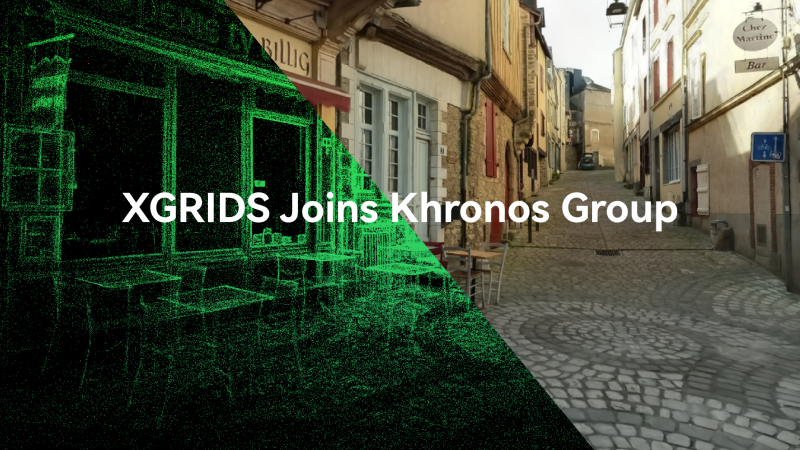
XGRIDS, a spatial intelligence company and one of the first companies to deploy 3D Gaussian Splatting at production scale across multiple industries, today announced its membership in the Khronos® Group.

XGRIDS wins the IFA 2026 Netzwelt Innovation Award with PortalCam & LCC Scan, turning physical spaces into production-ready digital twins in real time.