
Tech Insights
True 5 mm Accuracy, Put to the Test: Inside the Lixel L3 Accuracy Validation
Lixel L3 achieves ≤5 mm accuracy at 1σ across 1,524 point pairs. See the five-step validation workflow and Leica TS60 benchmark test data.
Why Reality-Captured 3D Gaussian Splatting Is the Foundation of Physical AI
An XGRIDS Perspective
Large language models advanced at the pace they did because the digital world already contained enormous amounts of text and contextual information. Decades of web content, digitized books, code repositories, and structured databases gave LLMs like ChatGPT the raw material to learn patterns of human reasoning at scale.
But when AI systems need to operate in the physical world — when robots need to navigate warehouses, vehicles need to understand intersections, drones need to inspect infrastructure — they need something fundamentally different. They need spatial understanding: accurate 3D geometry, real-world appearance, physical structure, and the relationships between objects in space. This is what the industry increasingly calls world models for Physical AI.
The problem is that 3D and physical data is extraordinarily difficult to obtain compared to text. There's no equivalent of "crawling the internet" for spatial information. Every environment has to be individually captured, reconstructed, and structured before an AI system can learn from it.
3D Gaussian Splatting (3DGS) — built from real-world capture — is emerging as the most practical representation for producing this data: fast to render, photorealistic, and compatible with the simulation pipelines Physical AI depends on. But 3DGS on its own captures appearance, not physical accuracy. To produce spatial data that robots can train on, 3DGS needs to be grounded in precise geometry — the kind that comes from LiDAR and multimodal sensing, not cameras alone. That combination of visual fidelity and geometric truth is what turns a 3D scene into usable infrastructure, and it's the core of what we build at XGRIDS.
Physical AI refers to autonomous systems — robots, vehicles, smart spaces — that perceive, reason, and act in physical environments. NVIDIA, which has done the most to define and popularize the term, reported over $6 billion in Physical AI revenue in fiscal year 2026 and projects the broader market could reach hundreds of billions over the coming decade.
At GTC 2026 (March 16–19, San Jose), Jensen Huang went further. He declared that "Physical AI has arrived — every industrial company will become a robotics company," and announced the Physical AI Data Factory Blueprint — an open reference architecture for generating, augmenting, and evaluating training data for robotics and autonomous systems at scale. The stated goal: turn robotics' data problem into a compute problem, using simulation and synthetic data instead of expensive real-world collection — provided the simulation environments are faithful enough to reality. That condition is the crux of everything that follows.
To train a robot to pick objects off a shelf, navigate a construction site, or inspect underground infrastructure, you need a simulation environment that accurately represents that specific shelf, site, or tunnel. Generic 3D environments can't capture the irregularities that matter: uneven floors, specific lighting, surface wear, spatial relationships that only exist in a particular location. Physical AI systems need spatially accurate, physically grounded, visually faithful digital replicas of the places they'll actually work in.
The gap between simulated and real environments has traditionally been framed as either a physics problem (simulated friction doesn't match reality) or a visual problem (robots see textures and lighting in the real world that don't exist in simulation). The reality is that structure, physics, and vision are all essential — and a failure in any one breaks the transfer. A photorealistic render is useless if the geometry is 10cm off. Perfect geometry with cartoon textures fails vision-based policies. Accurate structure and appearance fall apart if the simulation can't model object interactions.
Three lines of research illustrate how closing the visual and structural gaps translates to measurable sim-to-real improvement:
SplatSim (Carnegie Mellon, 2024) replaced traditional mesh-based rendering in simulation with 3D Gaussian Splatting. Policies trained on photorealistic 3DGS-rendered data and deployed to real robots in a zero-shot manner — meaning no real-world fine-tuning — achieved an average success rate of 86.25% (with standard data augmentations such as noise injection and color jitter), compared to 97.5% for policies trained directly on real-world data.
RL-GSBridge (2024) tested the structural dimension more directly by comparing policies trained on traditional mesh-rendered simulation against policies trained on 3DGS-rendered simulation. For both structured objects (simple cubes) and unstructured ones (complex textures), the mesh-trained policies showed significant success rate drops when transferring to real-world deployment, while the 3DGS-trained policies maintained substantially higher performance.
Discoverse (Tsinghua University's AIR DISCOVER Lab, 2025) combined the visual and physical dimensions by building a full 3DGS-based simulation platform integrated with the MuJoCo physics engine. In imitation learning benchmarks using ACT (Action Chunking with Transformers), Discoverse outperformed SplatSim by 18.5% on sim-to-real transfer when using the same data augmentation methods; on Diffusion Policy tasks, the improvement was 11.4%. The gains came from both higher visual fidelity and tighter physics integration — supporting the argument that these dimensions compound, not substitute.
Disclosure: XGRIDS provides hardware and software support for the Discoverse project. We cite the published, peer-reviewed benchmarks here, but readers should be aware of this relationship.
There are several ways to create 3D environments for simulation. Traditional mesh modeling, photogrammetry, Neural Radiance Fields (NeRF), and 3D Gaussian Splatting all produce 3D content. But they aren't equally suited to the demands of Physical AI training.
| Property | Why It Matters for Physical AI | 3DGS Advantage |
| Visual fidelity from real capture | Vision-based AI policies fail when training visuals diverge from deployment conditions. | 3DGS reconstructs scenes directly from camera/LiDAR data, preserving real-world textures, lighting, and spatial detail that artist-made assets can't replicate. |
| Real-time rendering | Reinforcement learning requires millions of rendered frames. Slow rendering creates bottlenecks that make large-scale training impractical. | 3DGS renders at real-time framerates — orders of magnitude faster than NeRF — making interactive training loops feasible. |
| Explicit spatial data | Physics engines need geometry they can compute collisions and dynamics against. Implicit representations (like NeRF) can't directly interface with physics. | Each Gaussian carries explicit position, scale, and rotation — compatible with mesh binding for physics simulation (as demonstrated in RL-GSBridge, Discoverse). |
| Structured spatial output | Physical AI systems need more than pixels — they need navigable maps, obstacle boundaries, surface normals, and semantic labels to plan and act. | LiDAR-fused 3DGS encodes metrically accurate spatial structure that can be queried, annotated, and converted into formats simulation platforms consume (OpenUSD, etc.). |
| Large-scale scene support | Robots operate in warehouses, construction sites, and cities — not tabletop setups. | LiDAR+vision fusion 3DGS can reconstruct building-to-city-scale environments with centimeter-level accuracy, far beyond single-room captures. |
One distinction worth drawing clearly: not all 3DGS is created equal for Physical AI purposes.
AI-generated 3D tools can produce visually striking 3DGS models from a handful of photos. Someone can take a few snapshots of their kitchen and get a beautiful, navigable 3D scene. But that model has no reliable relationship to the physical reality of the space — the dimensions may be approximate, the geometry may be hallucinated in occluded areas, and there's no metrically accurate spatial structure for a physics engine to simulate against. It looks right. It isn't right, in the ways that matter for training a robot.
For Physical AI, the capture source determines the quality ceiling of everything downstream. The question isn't whether you can generate 3DGS — it's whether the 3DGS encodes the structured spatial and physical data that simulation pipelines actually need.
At GTC 2026, Jensen Huang returned to a slide he called his favorite: a map of the structured data ecosystem — SQL, Spark, Pandas, Snowflake, Databricks, and the major cloud platforms. "This is the ground truth of business," he said. "This is the ground truth of enterprise computing." His argument: generative AI needs structured data to be trustworthy, and the entire enterprise stack needs to be redesigned around accelerating it.
.png)
The same principle applies to Physical AI, with a spatial twist.
For AI systems that operate in physical space, the ground truth isn't rows in a database. It's structured 3D data that accurately describes the geometry, appearance, and spatial relationships of real environments. If structured enterprise data is what makes language AI reliable, then structured spatial data is what makes Physical AI reliable.
This is the lens through which we think about our file format, LCC (Lixel CyberColor). LCC is designed to carry the structured spatial information: geometry, color, position, and scale that Physical AI pipelines consume. When NVIDIA's Omniverse NuRec converts sensor data into interactive simulations using 3DGS, the quality of what comes out depends entirely on the quality and structure of what goes in. LCC is our answer to what that structured input should look like: an open format built to preserve the spatial fidelity that downstream simulation, rendering, and AI reasoning depend on.
If structured data is the ground truth of enterprise AI, structured spatial data is the ground truth of Physical AI. And the capture-to-format pipeline that produces it is infrastructure, not a feature.
3DGS is fast and photorealistic. But on its own, a standard 3DGS reconstruction isn't simulation-ready. There are specific gaps between what raw 3DGS produces and what a Physical AI training pipeline consumes. XGRIDS' platform is built around closing those gaps.
Standard 3DGS works well in controlled conditions — good lighting, clear textures, moderate scale. In the environments where Physical AI systems actually deploy (underground tunnels, industrial facilities, multi-floor buildings), pure vision-based 3DGS breaks down. XGRIDS' pipeline uses SLAM-based LiDAR+vision fusion to maintain geometric accuracy in challenging conditions: non-ideal lighting, fine structures, weak textures, and large-scale environments that exceed the range of camera-only capture.
3DGS captures what a scene looks like. For simulation, you also need to know how it behaves — where surfaces are, what's solid, what a robot can collide with. XGRIDS' LiDAR fusion captures accurate depth and layered spatial structure, and the LCC pipeline simultaneously generates mesh geometry for physics collision alongside the 3DGS visual representation. This dual output — splats for rendering, mesh for physics — is what lets the same capture feed both the visual and physical layers of a simulator.
Consider a mining operation that needs to simulate autonomous vehicles in underground tunnels. The environment is dark, dusty, and geometrically complex. Pure vision-based capture struggles in these conditions. LiDAR provides the geometric backbone; vision provides the surface appearance. Fusing both produces a 3DGS environment that's both measurably accurate and visually faithful — the kind of environment where the gap between capture methodology and AI training outcome becomes most visible.
Real-world captures contain noise that simulation environments can't use: moving people, parked vehicles, temporary objects. XGRIDS' pipeline includes dynamic object removal and semantic spatial recognition, producing clean environments where every element is identifiable and queryable. This structured output is what lets downstream systems reason about space — not just render it.
.gif)
Dynamic Object Removal
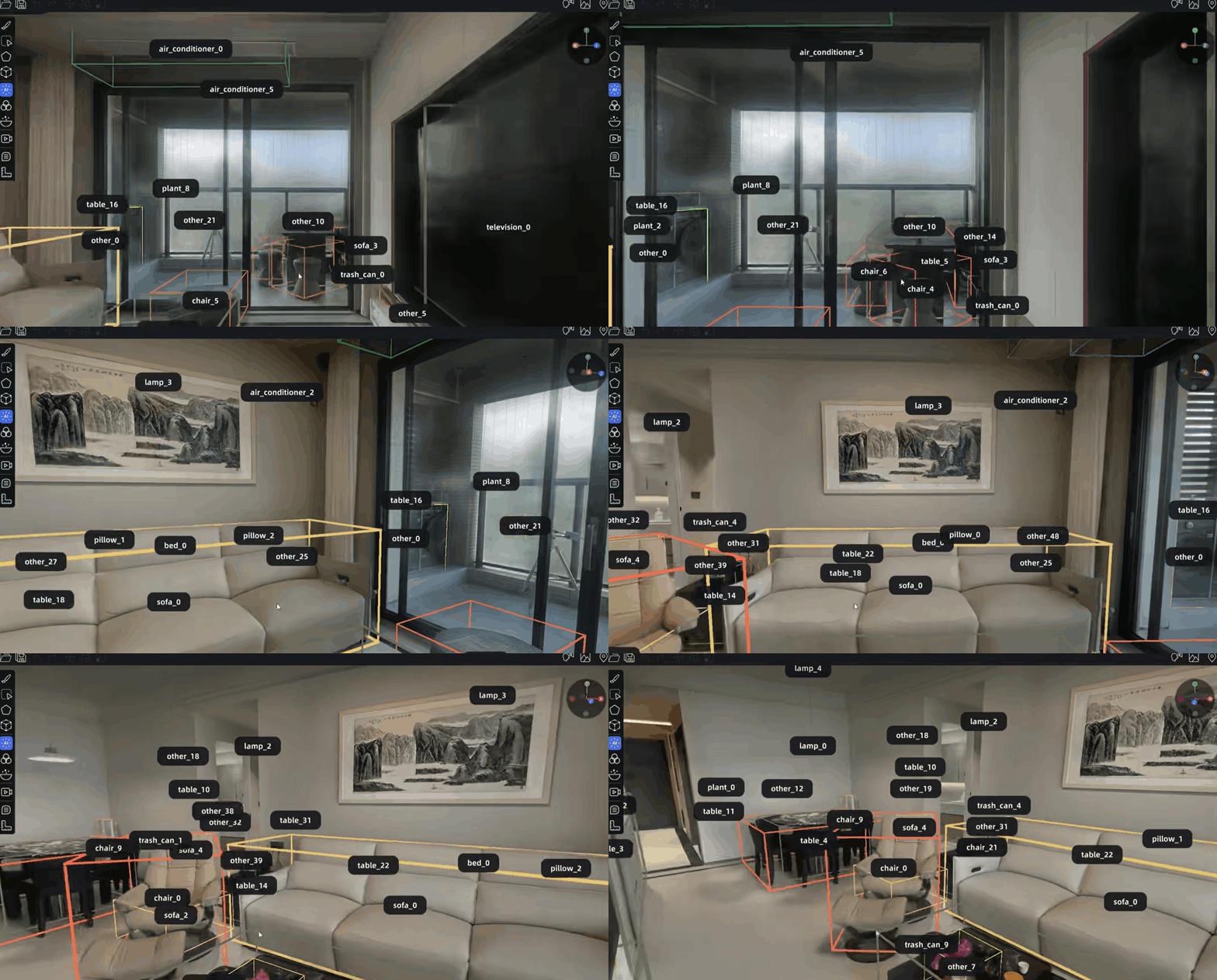
Semantic Spatial Recognition
The LCC format organizes 3DGS data into discrete spatial layers, with different layers carrying different types of spatial information. Large-scale environments are loaded using a Level of Detail (LOD) strategy, so downstream systems access only the resolution they need. This layered structure is what makes the data machine-readable, not just visually accurate.
.png)
The pipeline doesn't stop at producing a 3D model. XGRIDS' Real2Sim workflow exports directly into NVIDIA Isaac Sim, where robot policies are trained and validated. This workflow is published in NVIDIA's official Isaac Sim documentation under Community Project Highlights as "From LCC-3DGS Scan to Simulation: Accelerating Scene Generation in Isaac Sim" — a validation that XGRIDS' spatial data meets the structural consistency, physical plausibility, and engineering stability requirements of NVIDIA's Physical AI training infrastructure.
At GTC 2026, this pipeline was demonstrated across three venues: the Inception stage (presented by Director Sunny Liao), the NVIDIA Robotics session, and the AWS partner showcase.
.png)
One demonstration made it tangible. On the NVIDIA main stage, Blue — the humanoid robot developed jointly by NVIDIA, Google DeepMind, and Disney Research — was shown training in a digital twin of NVIDIA's headquarters office space: learning to understand its environment, plan paths, and act. That training environment wasn't a manually built virtual scene. It was a complete digital reconstruction of the real NVIDIA office, captured and converted into a simulation-ready world model through XGRIDS' Real2Sim pipeline. The robot trained at scale in a faithful replica of the space it would eventually operate in — without ever entering the physical building during the learning process.
These four capabilities map onto what we call the Sense → Reconstruct → Understand → Create framework — our model for what it takes to produce spatial data that Physical AI can actually use:
| Stage | What It Does | Why It Matters for Physical AI |
| Sense | LiDAR + vision fusion hardware captures environments with centimeter-level geometric accuracy and photorealistic appearance in a single pass. | Captures the deployment environment as it actually is — specific spatial conditions, real materials, existing obstacles. |
| Reconstruct | Automated 3DGS processing pipeline produces building-to-city-scale models without manual mesh cleanup or texture baking. | Generates simulation-ready 3D environments at the scale Physical AI actually operates — beyond single-room captures. |
| Understand | Spatial measurement, annotation, and semantic tagging built into the reconstruction workflow. | Provides the spatial context AI systems need: what's where, how big, how far, what's navigable. |
| Create | Output in LCC format, with support for NVIDIA Omniverse NuRec for OpenUSD-based rendering. | Seeds the Physical AI Data Factory with high-fidelity base environments that synthetic data generation then scales. |
NVIDIA's GTC 2026 announcements make the Physical AI architecture clear. Omniverse NuRec handles 3DGS-based world reconstruction. Cosmos models generate and augment synthetic training data. Isaac Sim runs the simulation. GR00T and Alpamayo provide the robot and vehicle foundation models. The Physical AI Data Factory Blueprint orchestrates the pipeline from data curation to training.
But this pipeline has an input dependency: someone has to capture the real-world environments that seed the entire system. NVIDIA builds the simulation and training stack. The capture layer — the part that turns physical spaces into structured 3D data the stack can consume — is where XGRIDS operates.
Today, most 3DGS-for-robotics research relies on ad hoc capture setups: researchers mount cameras on tripods, walk through rooms, and process the data themselves. This works for publishing papers. It doesn't work for deploying Physical AI across thousands of warehouse locations, construction sites, or urban corridors.
The parallel to early deep learning is instructive. A decade ago, the companies that built scalable data labeling pipelines became essential to the AI industry — not because they trained the models, but because they produced the data those models required. Gartner projects synthetic data will constitute 90% of AI training data for edge scenarios by 2030, up from roughly 20% today. But synthetic data is generated from seed environments. The higher the fidelity of those seeds, the better the synthetic variations that grow from them.
Reality-captured 3DGS is the seed layer. And producing it at scale — through the Sense → Reconstruct → Understand → Create pipeline — is an infrastructure problem.
Claiming 3DGS solves Physical AI simulation would be inaccurate. There are real, well-documented limitations that the field is actively working through:
| Challenge | Current State |
| Physics integration | 3DGS is primarily a rendering representation. Binding Gaussians to mesh geometry for collision detection and dynamics simulation works (RL-GSBridge, Discoverse), but adds pipeline complexity. There's no standardized approach yet. |
| Dynamic environments | Most 3DGS captures represent static scenes. Real environments have moving people, vehicles, changing lighting. ReaDy-Go augments static GS scenes with animated human GS models, but full dynamic capture-to-simulation remains open. |
| Material properties | 3DGS captures visual appearance but not physical material properties — friction, deformability, weight. These still require separate modeling or estimation. |
| Rigid body limitation | Current 3DGS-based sim2real frameworks are largely limited to rigid body manipulation. Handling cloth, liquids, granular materials in 3DGS-based simulation is still early-stage. |
| Synthetic data scaling | NVIDIA's Physical AI Data Factory Blueprint addresses data augmentation and evaluation, but the base real-world capture (the seed data that synthetic generation expands from) still needs to be high-fidelity. Garbage in, scaled garbage out. |
These aren't hypothetical gaps — they're constraints that practitioners encounter in production. Acknowledging them is part of building systems that actually work, rather than overpromising on capabilities that don't yet exist.
Physical AI is moving from research demos to deployment. NVIDIA's Omniverse NuRec libraries now include 3DGS reconstruction for large-scale environments. Open-source frameworks like Discoverse are standardizing the Real2Sim2Real pipeline. According to NVIDIA, robotics is now the fastest-growing category on Hugging Face.
The bottleneck is shifting. It's less about whether 3DGS can produce environments good enough for training — the research has answered that. It's about whether the industry can produce enough high-quality, reality-captured 3D environments, fast enough, at the scales that deployment requires.
That's a platform-scale challenge. And it's the one we're building toward.
Lixel L3 achieves ≤5 mm accuracy at 1σ across 1,524 point pairs. See the five-step validation workflow and Leica TS60 benchmark test data.
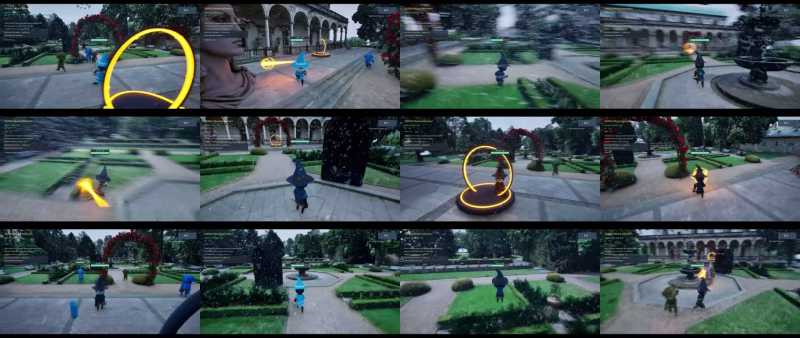
A garden scan became a playable Unreal Engine game in under two hours, with 3D Gaussian splatting for the level and an AI agent for the game logic.
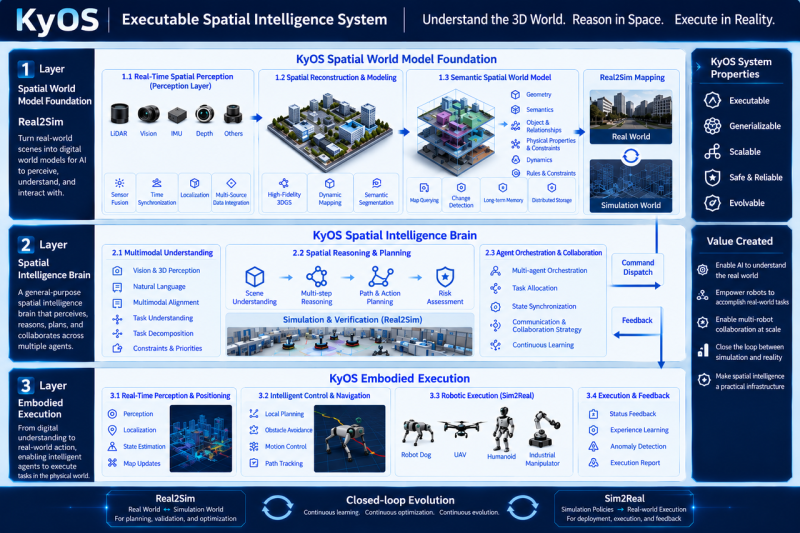
Scaling embodied AI requires KyOS, a closed-loop architecture coordinating perception, task planning, and reflex control across different timescales.

Turn static 3DGS captures into dynamic lighting variations using AI relighting tools to test sunsets, night looks, and mood changes in minutes.