Case Studies
Virtual Pre-Production for Netflix's Monster: The Lizzie Borden Story.
Reality capture let Netflix's Monster scout 35 Italian locations in four days with PortalCam, then plan shots remotely through virtual scouting of 3DGS scans.
Josette Seitz on 3D storytelling with XGRIDS
The Venice Carnival picks a new theme every year. In 2026, it was "Olympus," a tribute to the Winter Olympics unfolding a few hours away in Milan. Josette Seitz was standing in front of the Carnival stage in February when it hit her: this exact arrangement of props, costumes, lighting, and crowd energy would never exist again. Next year, it'll be a new theme, a new stage. This version is singular.
That was the moment her trip stopped being "scan a few interesting spaces" and became something more deliberate.
Josette builds high-security virtual training systems for the aerospace industry by day. In her personal work, she's been using XGRIDS hardware to document places that won't last. Over a few weeks in Italy she captured the Duomo in Milan, the Olympic Flame beneath the Arco della Pace, the Clubhouse 26 exhibition at the Olympic Museum, the Olympic Rings, and that Venice Carnival stage. A few months earlier, she'd captured Burning Man with the Lixel L2 Pro and a drone.
Two kinds of ephemeral space, on opposite ends of the earth. One designed to burn. One scheduled to close. This is what she learned doing both.
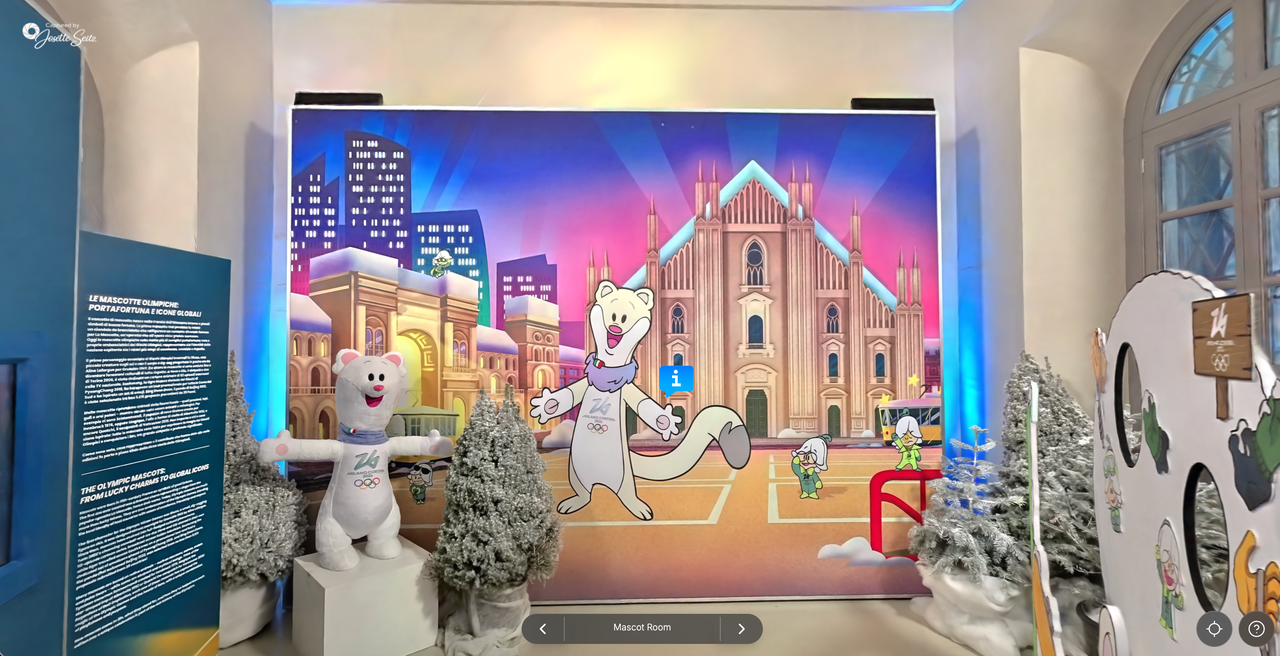
Mascot Room at the Clubhouse 26 exhibition during the 2026 Winter Olympics Milano Cortina
A photograph holds a frame. 3D Gaussian Splatting holds a room — the spatial relationships between objects, the way your perspective shifts as you move, the atmosphere of actually being inside a space.
Clubhouse 26 at the Olympic Museum is the cleanest example of why this matters. Winter Olympic medals from 1924 to 2026 were arranged in sequence. Posters traced a century of visual identity. The layout wasn't decorative, it was the exhibit. A walk through the room was a walk through Olympic history.
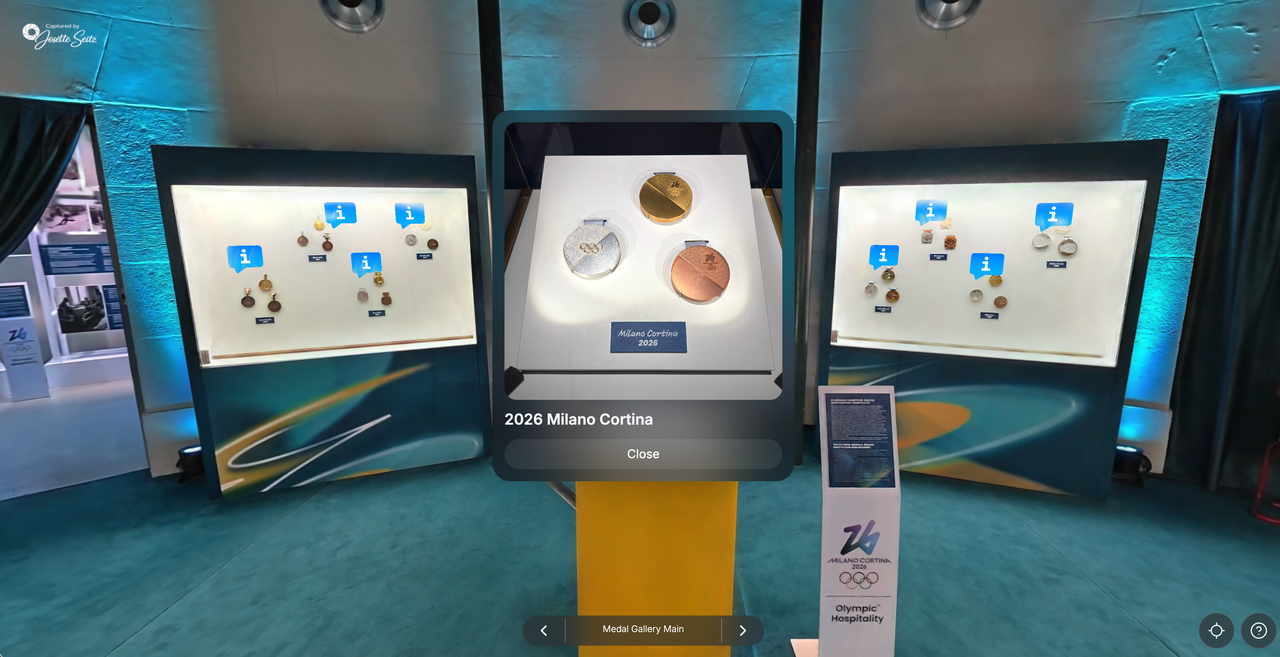
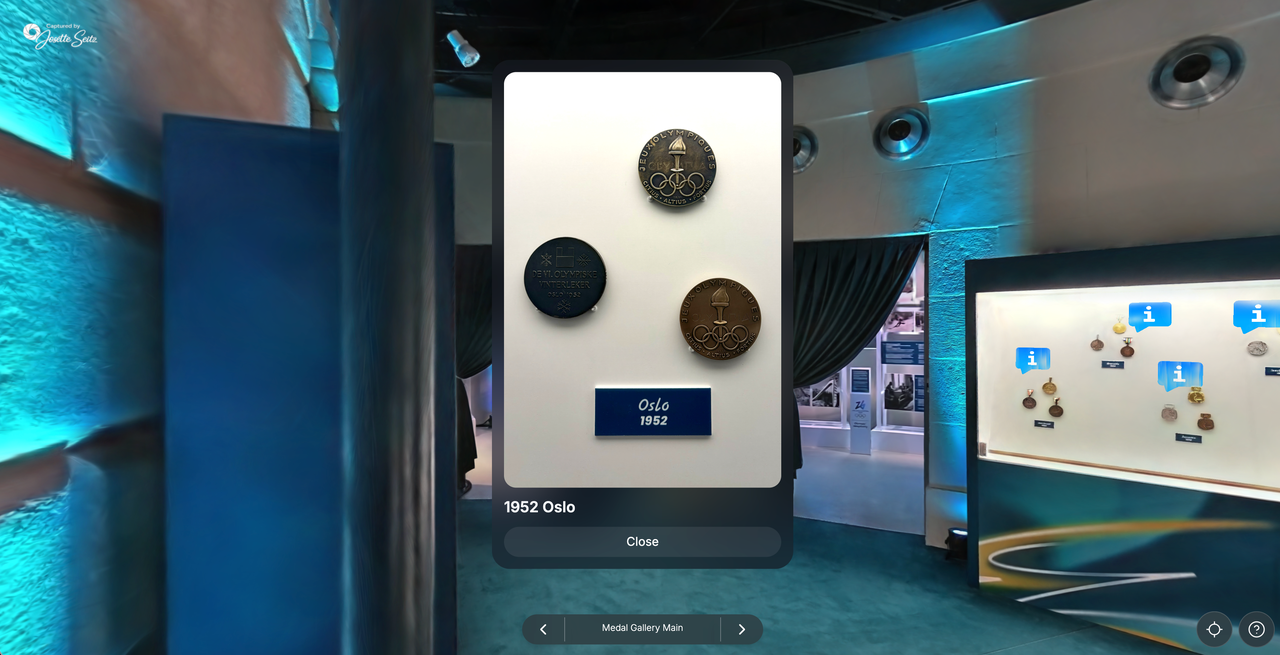
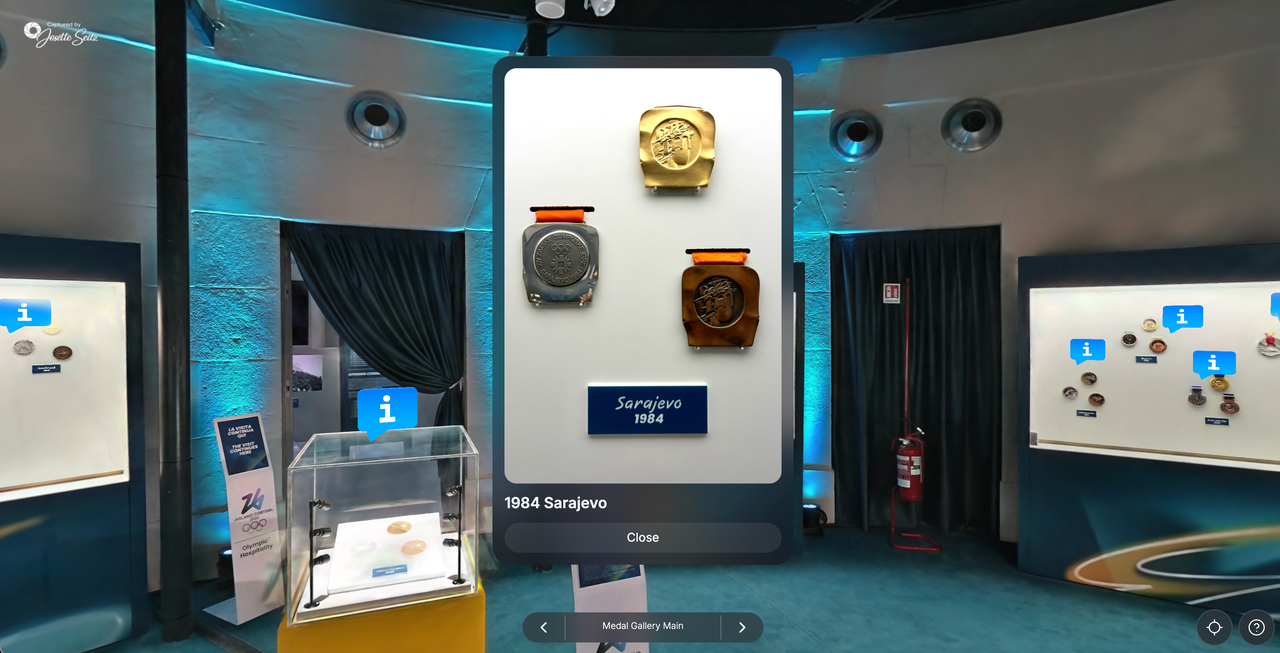
Explore the Clubhouse 26 capture here.
"The Winter Olympic medals from 1924 to 2026 weren't just displayed, they were positioned in a way that physically guided you through a century of Olympic history. As you move through the Clubhouse 26 Gaussian splat, you're not just looking at individual medals, you're experiencing the progression of their design over the years. The older medals feel more compact and traditional, while the newer ones feel more expressive and modern. This transition only really makes sense when you can move through the space."
"A photo isolates an object. The splat preserves the relationship between objects, the spacing, sequence, and the way your perspective changes as you move."
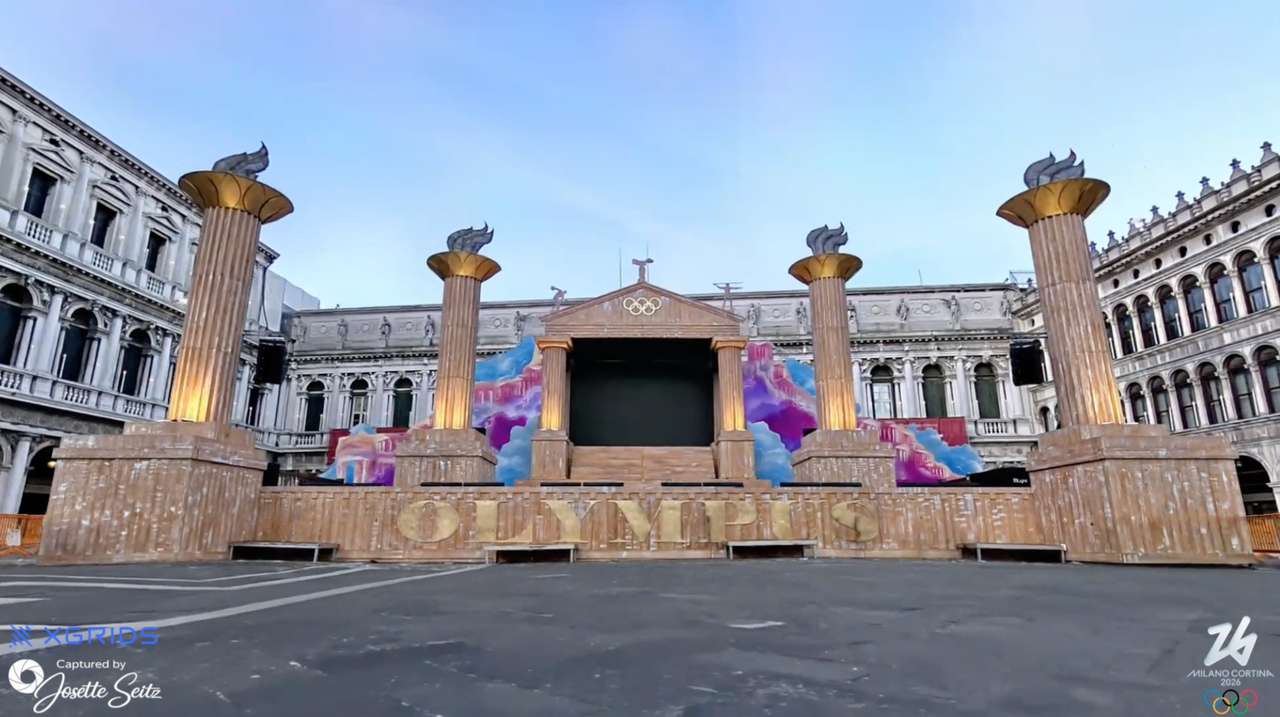
3DGS model of the Olympus Carnival Stage, located in San Marco Plaza in Venice, Italy
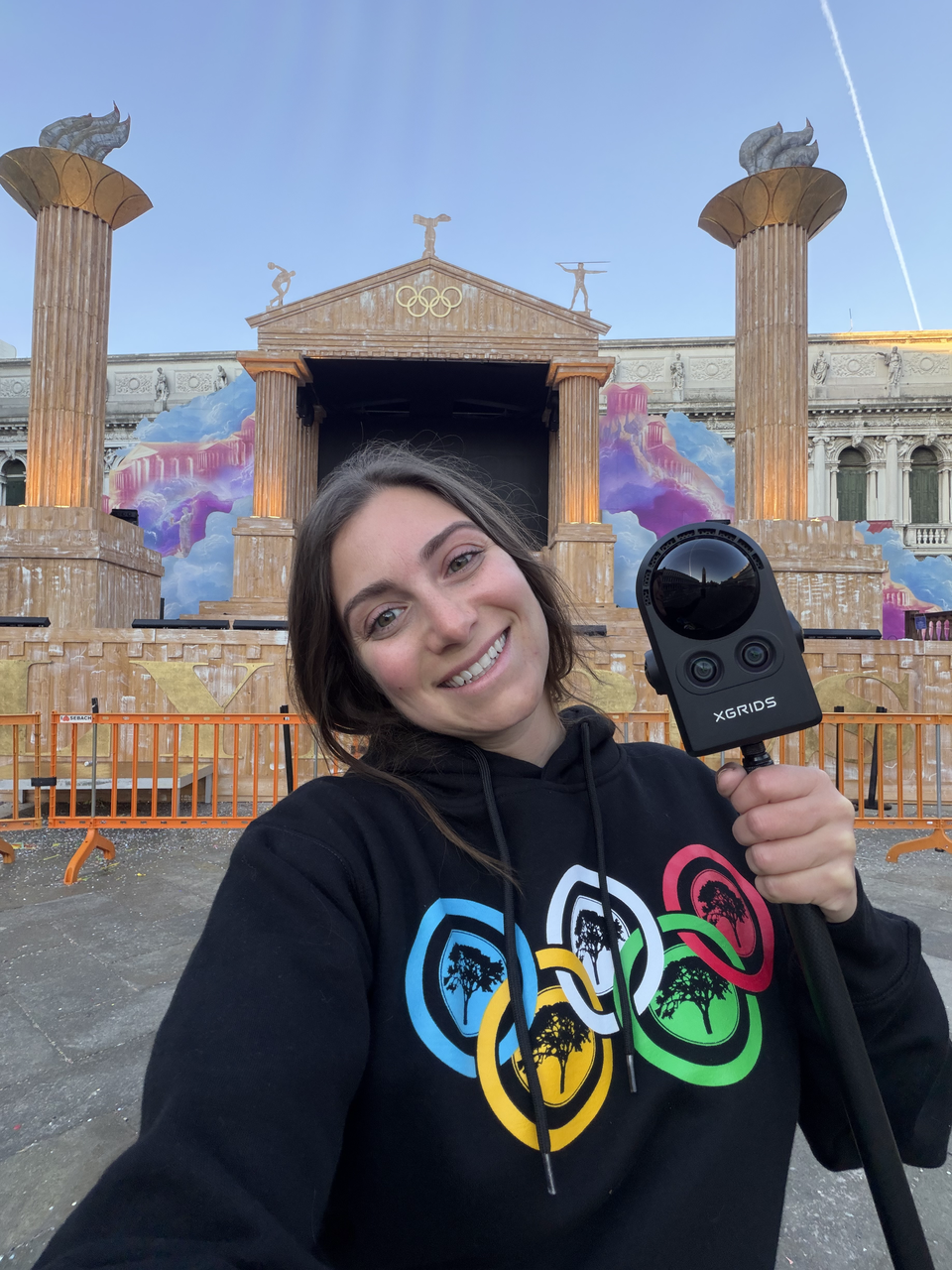
Josette with PortalCam on an extention pole at the Carnival stage
Burning Man sits at the other end of the ephemerality spectrum. Its art is built to disappear — the fire is the point. Capturing those pieces meant working the ground with the L2 Pro and the sky with a drone. What came back surprised her.
https://youtu.be/aAMKxuAwxfY?si=egLoq3HbFEPLSpZc
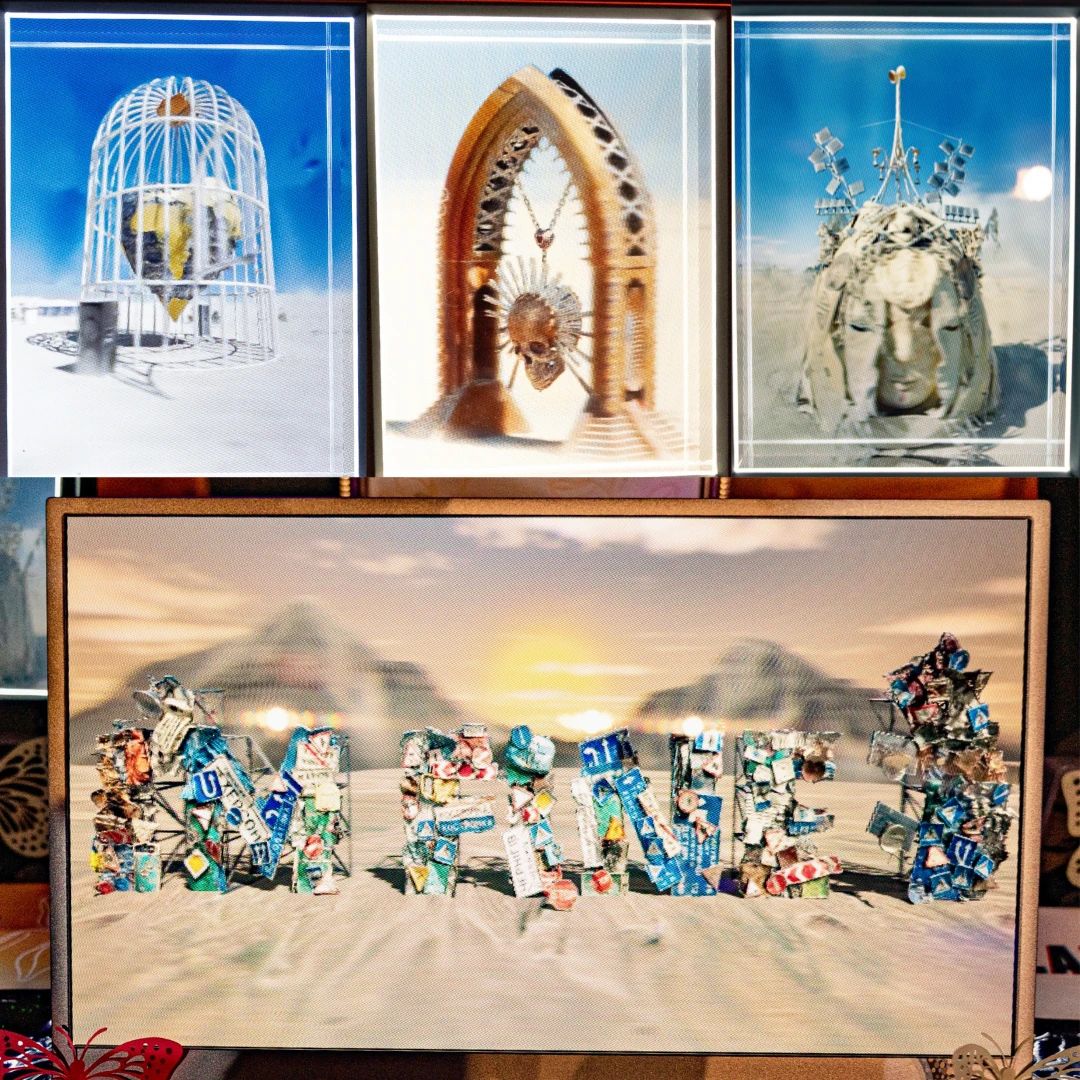
"When I returned home and viewed the scans for the first time, especially in VR, I was honestly in awe. It brought me right back to that moment in the desert, reconnecting me with the art and the memories in a way I didn't expect. The most surprising moment happened while I was capturing from the air. Using a drone, seeing those once-in-a-lifetime art sculptures from above gave them an entirely different meaning. There was something about that perspective, the scale, the way the sculptures sat in the desert, that hit my soul on a much deeper level than being on the ground."
The Aerial-Ground Fusion workflow in LCC Studio combined both inputs into a single scene. Ground capture alone would have missed the scale. The drone alone would have missed the detail. Together, they held the full sculpture — the way you stood next to it and the way it sat inside the desert that would eventually take it back.
Her own summary of why this matters, for anyone thinking about 3D capture for cultural or temporary spaces:
"Sculptures and spaces don't feel the same once they're gone. You lose the context, the atmosphere, and the moment they existed in. That's why capturing ephemeral spaces is so important. It encourages people to slow down, appreciate what's in front of them, and find a deeper sense of gratitude. These moments aren't permanent, and 3D capture isn't just documentation, it's a way to hold onto experiences we might otherwise take for granted."
The Italy trip and the Burning Man trip were roughly the same ambition — preserve something temporary, at high fidelity, well enough to re-enter it years later. The conditions couldn't have been more different. Josette picked different hardware for each, and her reasoning is worth walking through, because anyone looking at the XGRIDS lineup is going to ask the same questions she did.
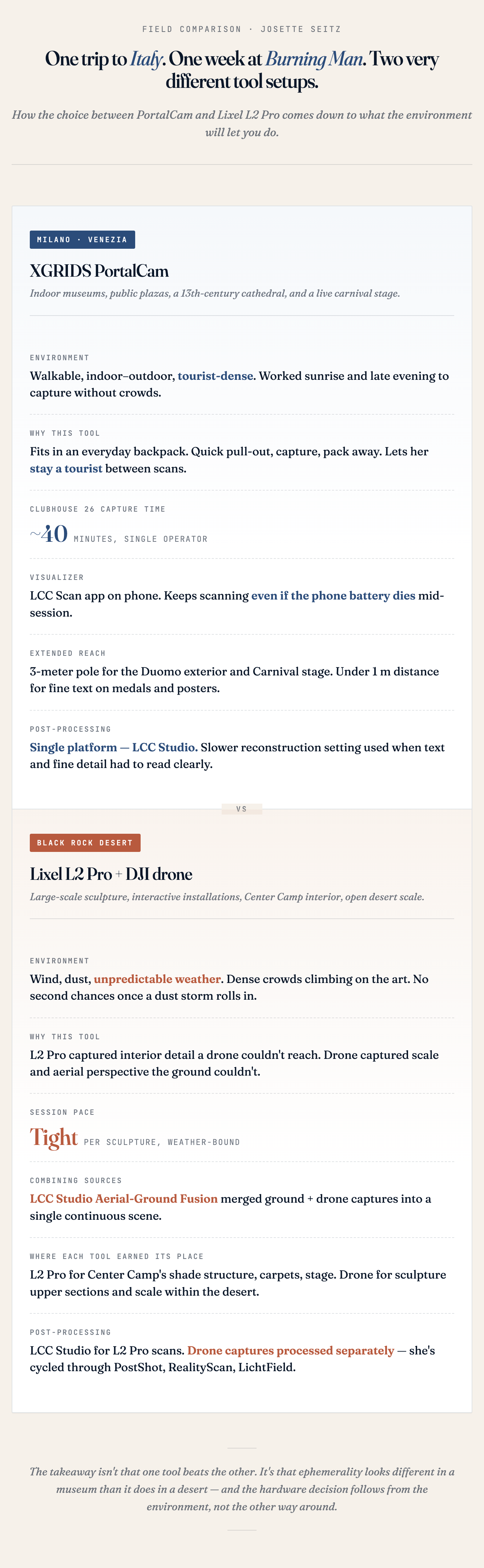
What made the PortalCam work for Italy wasn't any single feature. It was the ability to carry it everywhere without it becoming The Thing she was doing on the trip.
"Without the XGRIDS PortalCam, I honestly do not think we'd be having this conversation or case study today. Traveling to Italy, navigating between Milan and Venice, the device's size and ease of use made it the perfect tool for capturing. Having the visualizer on my phone through the LCC Scan app was a huge advantage while scanning. There were times when my phone battery was low and I could still continue scanning without the visualizer."
"What I loved most was how quickly I could pull out the XGRIDS PortalCam, capture high-fidelity scans, and pack it away without any issues. Not only did it feel rewarding to capture these environments across Italy, but it also allowed me to enjoy the experience as a normal tourist. I could grab lunch or stop for a café along the way."
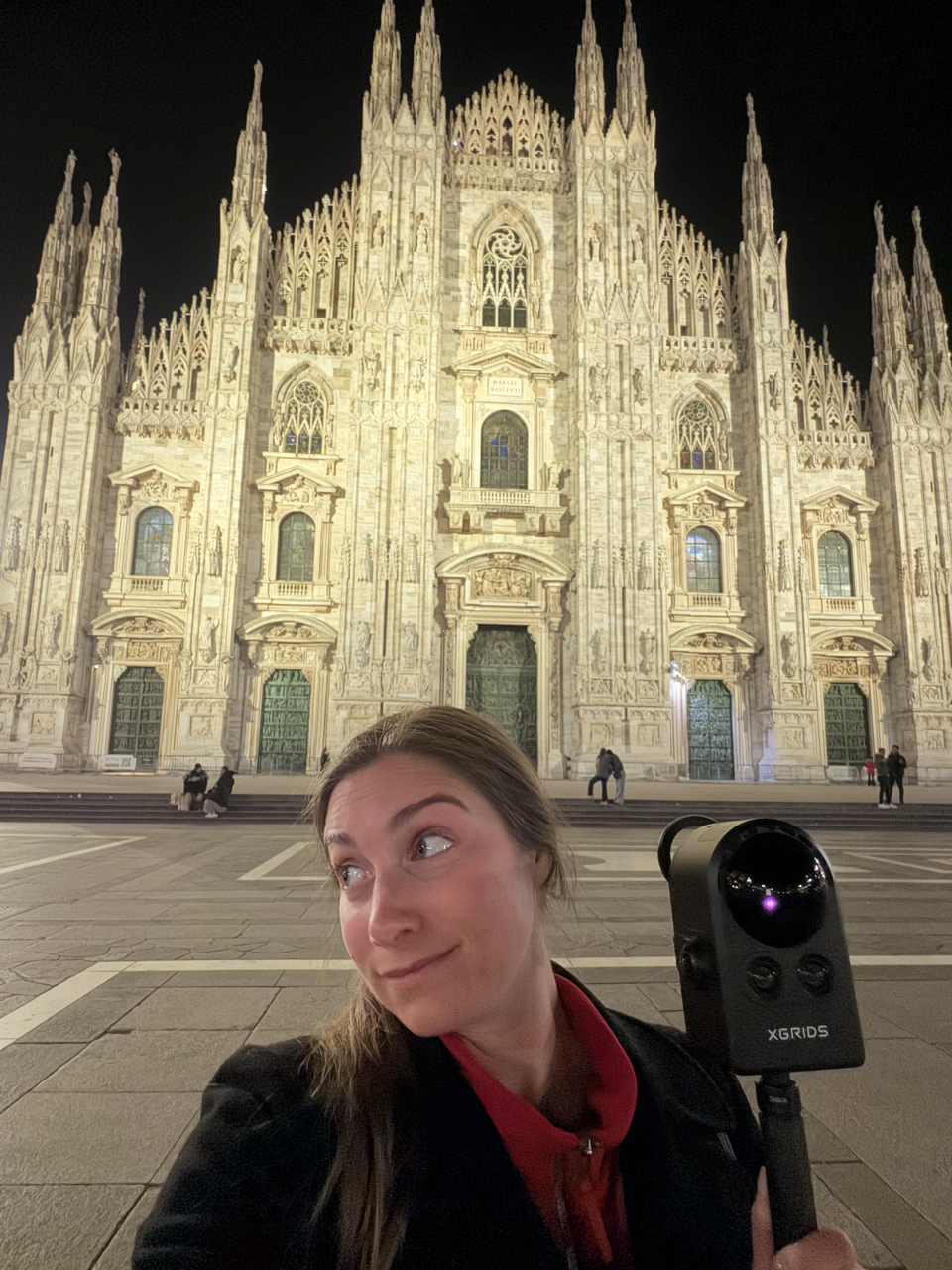
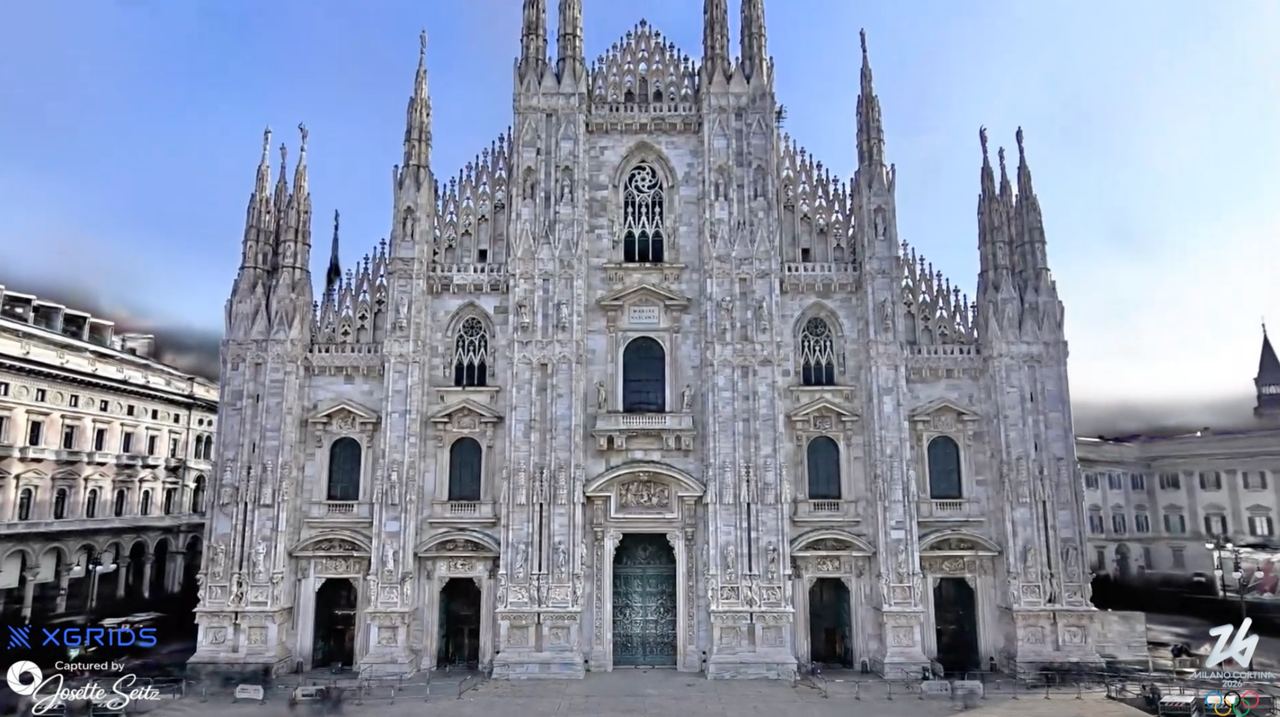
Josette with PortalCam at Duomo di Milano
For public sites like the Duomo, she worked sunrise and late evening to stay out of the crowds. Those quiet sessions became part of the memory, not just the method.
"I would get up around sunrise for daytime scans, and for night captures, I would go out very late in the evening when the crowds were minimal or gone entirely. Those sunrise scans are something I'll never forget. Seeing Italy in such a peaceful setting, with the sun coming up, was an incredible way to start the day."
At Burning Man, the variables flipped. Wind, dust, interactive crowds climbing on the art, and spaces a drone physically can't enter. Center Camp — a central hub with a shade structure, carpets, cushions, and a small performance stage — needed a tool that could go inside as well as around.
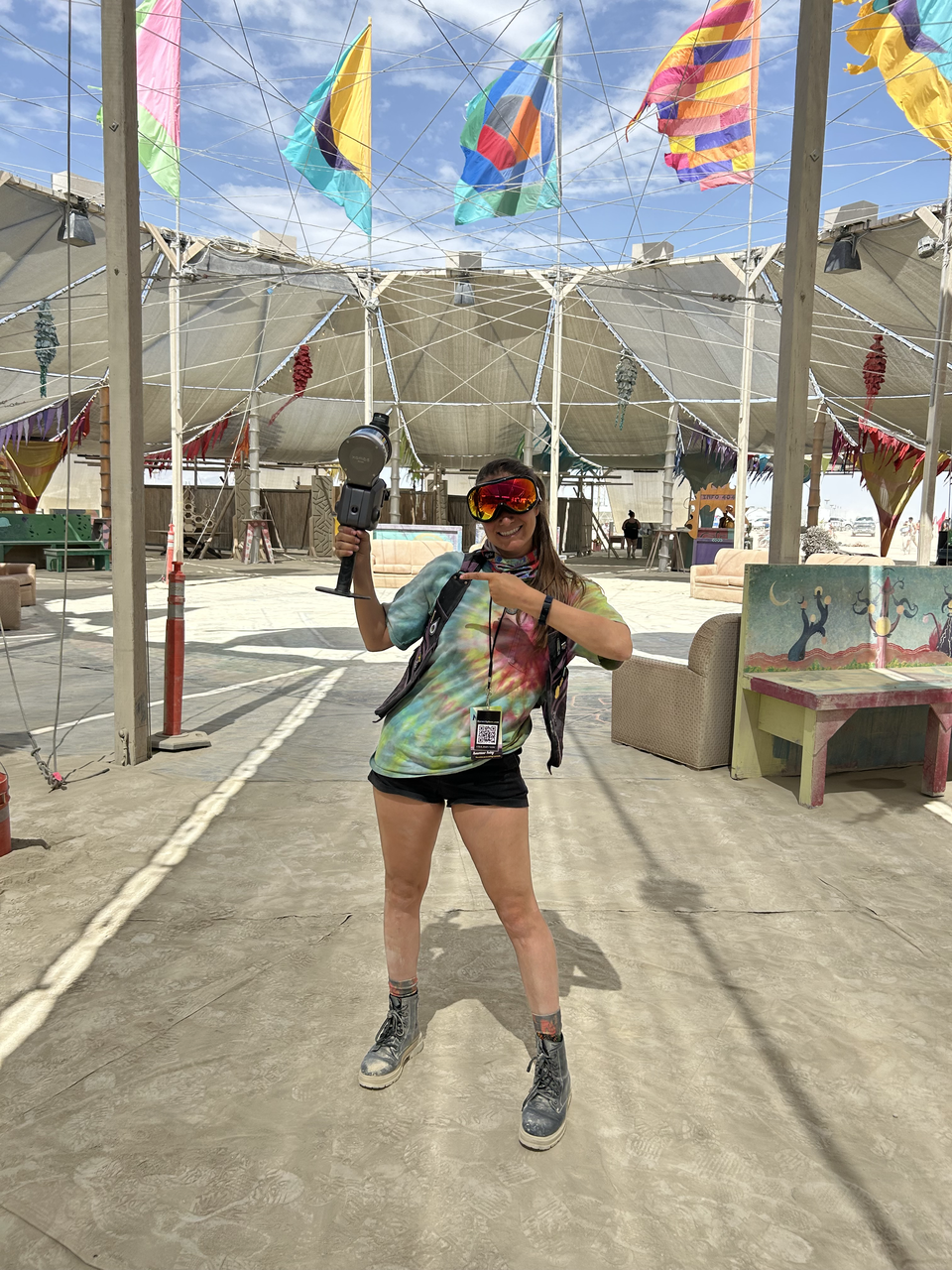
Josette with L2 Pro at Burning Man
"To capture all the details, the smaller elements, the textures, and everything within the structure, the L2 Pro was the best tool we could use. A drone wouldn't have been able to capture that level of detail or navigate the interior space as accurately."
The drone earned its role on sculpture exteriors and scale shots. LCC Studio's Aerial-Ground Fusion brought both sources into one continuous scene.
On post-processing, her comparison is the kind of candid detail most case studies sand off:
"With XGRIDS LCC Studio, everything is streamlined. You can process, edit, and export your captures, all within a single platform. For drone captures, the workflow is more varied. I typically rely on different software options like PostShot, RealityScan, or LichtField. In the past, I used PostShot, but over time I wasn't as satisfied with the results and transitioned to LichtField. Overall, I've been most impressed with LCC Studio. The results are consistently accurate, high-fidelity, and the process itself is straightforward without being overly complex."
One practical detail worth pulling out for anyone chasing detail-heavy captures: on Clubhouse 26, she used LCC Studio's slower reconstruction settings specifically so the text on medals and posters would resolve. Scanning distance under a meter, plus the 3-meter pole for higher coverage, made the difference between a splat that shows the exhibit and a splat where the typography actually reads.
The 3D community will find Clubhouse 26 and be impressed by the fidelity. That's not the audience Josette is thinking about.
"Beyond the 3DGS community, I'd most want athletes, coaches, and members of the International Olympic Committee to experience this capture through Nucleus4D. The Clubhouse 26 space was originally designed as an ephemeral environment for athletes and coaches during the Olympics, but in reality, many of them were focused on their events and didn't even realize the space existed in Milan. That makes this digital version especially meaningful, it gives them a second chance to experience something that was created for them but may have been missed in the moment."
That logic scales beyond the Olympics. Any major cultural event builds spaces for its participants, then takes them down. A biennale. A World Cup. A festival. Josette captured Milan and Venice solo, in everyday tourist mode. Full coverage of a Games-scale program isn't a hardware problem but more so a coordination one.
What she wants to try next points at where the medium is going.
"If I could go back in time, I'd focus on capturing people, especially in motion. Thinking about it through a 4D Gaussian Splatting lens, I'd love to preserve live moments like musical performances or dance. It's not just about preserving how something looked, it's about how it felt in the moment; the movement, the energy, the presence. For example, when figure skater Alysa Liu won the gold medal, it would have been incredible to capture her holding it, especially during that moment on the podium as the national anthem played."
4D Gaussian Splatting — space plus time — is active research in the 3DGS community right now. Josette's framing gets at why it matters for cultural capture specifically. A medal ceremony isn't a shape. It's an event. The geometry of the room is the least interesting thing about it.
She's also eyeing underwater capture, inspired by ReefLine, a sculpture park off Miami Beach she saw presented at Art Basel. It will be a different hardware problem, but the same instinct follows: where the tools haven't been yet.
For anyone working in cultural heritage, live events, art preservation, or venue documentation, Josette's work answers a practical question: what does it actually take, in hardware, time, and expertise, to preserve a space at quality that holds up years later?
Her answer across two very different environments: one backpack, a phone, a 3-meter pole, and a scanner that stays out of the way enough to let her just be there.
The spaces she captured won't come back. The Carnival stage gets rebuilt every year around a different theme. The Clubhouse 26 exhibit closed when the Olympics did. The Burning Man sculptures returned to the desert as ash. What remains is something neither photography nor video could hold — the room itself, walkable, navigable, re-enterable. A second chance to stand inside something that no longer exists.
Josette will be sharing more from these projects in an upcoming webinar on capturing ephemeral events and art. Details to follow.
Explore the Clubhouse 26 scan on Nucleus4D
Follow Josette's work: Instagram, josetteseitz.com, LinkedIn.
Reality capture let Netflix's Monster scout 35 Italian locations in four days with PortalCam, then plan shots remotely through virtual scouting of 3DGS scans.
.png?x-oss-process=image/resize,w_800/quality,Q_50)
A one-hour Lixel K1 scan of six Culver City blocks gave a generative film pipeline the fixed geometry it needed to keep six locations consistent.
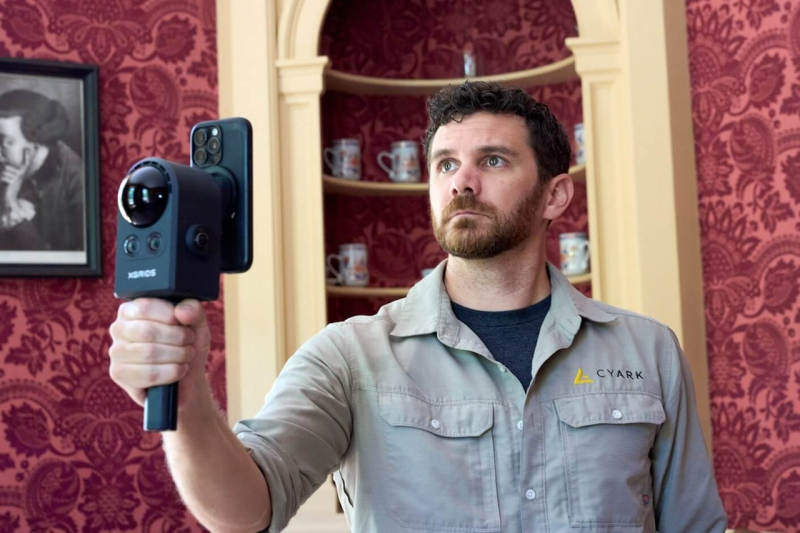
Handheld 3DGS by PortalCam helped CyArk document three landmark interiors for America 250, solving mirror reflections and low-light field challenges.
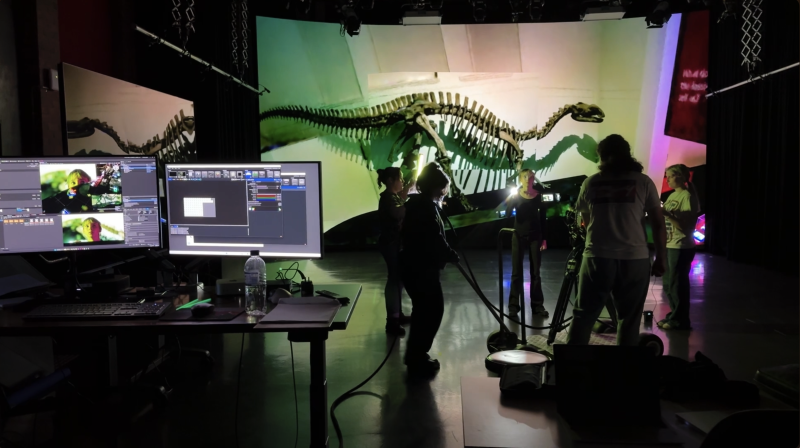
Handheld 3D capture brings real museum spaces to LED volumes, replacing green screens and photogrammetry for fast, cinematic virtual camera moves.